
How to Organise an Inclusive Science Fair: A Conversation with Soumaiya Imarraine
Soumaiya Imarraine is a neuroscientist—she completed her PhD at Sorbonne University in Paris—with a background in research, science communication, and societal engagement. She is also co-founder of the outreach initiative Cerveau en Fête (with fellow neuroscientist Nicole Ortiz) and a contributor to international scientific and community initiatives, including a project promoting equity and transparency in science.
Imarraine is the co-author of a paper published in JCOM about the inclusive science fair near Paris that she organised together with Ortiz. It targeted underrepresented groups by gender and socioeconomic status through hands-on activities. Feedback highlighted the benefits of active engagement and scientist interactions for boosting interest in science. Their study shows that such community outreach effectively promotes science literacy and participation.
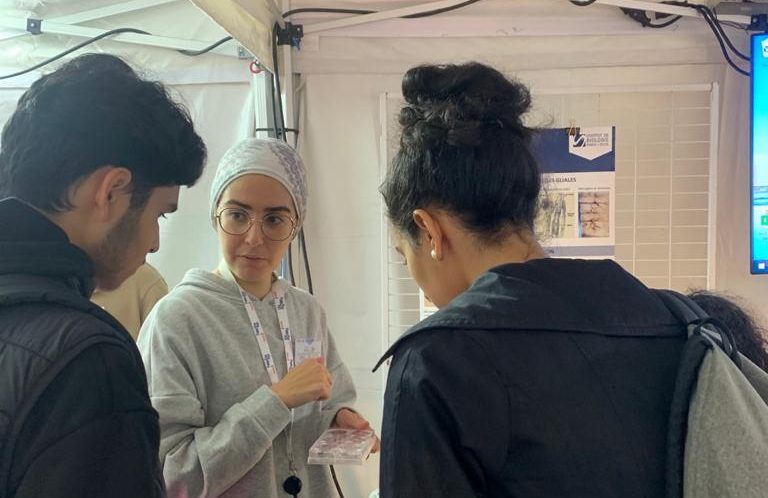
How did you and Ortiz come up with the idea of an inclusive science fair, and why did you want to address this specific aspect of science communication?
As a PhD student, I joined several science outreach projects and noticed they often lacked inclusivity: most activities took place at the university, requiring people to come to us.
Nicole Ortiz and I wanted to make outreach more inclusive by bringing science to the community and having two-way conversations. We worked on the event after hours, seeking grants and planning together.
While planning, we thought it would be nice to have a survey to gather people's opinions on the event, science in general, and what’s important to them in science outreach. That’s how we created the survey, with the idea of seeing if we could make something out of it. We were really positively surprised that most people agreed to fill it out. After analysing it, we found the conclusions really interesting and wanted to make them available to many people.
We know inclusivity is important, but it’s not always applied, especially in science outreach. So, we wanted to reinforce that point and show people that it’s feasible. It’s not expensive, you don’t need much time, but you can make some adjustments, and it goes a long way.
So you created this event just outside Paris, but how did you choose the other people to help you? For example, were the volunteers mostly scientists or science communicators?
For the volunteers, we mostly broadcast that in our network—through science institutes and on social media. Most volunteers were scientists: many PhD students, some research assistants, and a few non-scientists who came to help. They could welcome participants, give out surveys, and do things that didn’t require scientific knowledge. It was open to all, but we mostly got scientists.
In the paper published in JCOM, you and Ortiz critique how science events often reproduce exclusion, particularly through deficit models and spatial biases. So how can science communication or science outreach shift from focusing on audience size metrics to truly structural inclusion practices?
Well, basically, just ask the participants. That’s something that’s really easy but not always done. For us, that was the key, because then we did a second edition of the event. The only thing we had to do was come back to the survey and basically apply what people asked us to do. So they asked us for more activities; we did more. They wanted more fun; we tried to implement more fun. And then you improve from edition to edition: just talk to the people you're trying to reach.
We did the second event one year later, again during Brain Awareness Week. In the same town, because we were trying to create a kind of tradition for people—an annual meeting—and implement the remarks they had from the year before. And that second time, we had almost twice as many activities. We also had more partners, more volunteers, and a more diverse set of profiles, which was nice. So, it really shows that from year to year, you can try to improve. We also added some aspects: for example, we had one volunteer who was fluent in sign language, which we didn’t have the first time. So, we were also able to advertise that the event was accessible for wheelchair users and for people who needed sign language translation. Small details, but they matter.
You also emphasised that hands-on activities are more effective and more popular with the public than passive information delivery. Do you think there are good communication strategies that we can implement? Maybe the learning-by-doing approach could work?
Yes, definitely. So, people who are far from science or see it as this big, frightening thing can approach it more easily. And something that’s really easy is to go through games: then they’re not shy or anything; they just have to enjoy it themselves. And once you’ve created this game and fun aspect, people are more willing to ask questions and talk to you as a normal person, basically. So, games are the key, I would say. It’s the easiest way; it’s cheap and fast. Because it doesn’t matter whether you have the answer or not, whether it’s wrong or not—just say whatever you want, play the way you want, and it’s going to be fine.
Are you planning to do another round of this science fair?
That’s also the issue. You want to be inclusive, but it starts with us. At some point, it takes lots of time and money. So, we really wanted to do a proof of concept. It wasn’t the goal to do a one-time event. If we can reproduce it and improve it, that’s always the goal. So, as much as we can, we’re going to try—but the goal was also to broadcast it, since it can be replicated by anyone, anywhere. For example, I presented it at the SONA (Society of Neuroscientists of Africa) conference last year. Some people showed interest, so we're hoping it might get replicated.
Maybe some institution (like a big museum) can learn from this and say, "Okay, let’s take this approach and use our resources to do something similar in our city, country”...
Yeah, because everyone knows the theory, and sometimes people think doing it is very complicated, but it’s not. And that’s also why in the paper, we’re really hands-on—like in the annex, we even have a list of the materials you need, just to show it’s not much.

